The garage read 74 degrees on my meter, and I could still smell the lawnmower from the doorway. That one moment is why cooling a garage and ventilating a garage are two separate purchases. Air conditioning is a temperature machine. The things that actually threaten you out there have no temperature at all, and carbon monoxide, gasoline vapor, and solvent fumes don't care one bit that the room finally feels good.
This homeowner had done real work. He'd insulated the door, weatherstripped the perimeter, and sized his equipment correctly for the space. What he'd also done, without meaning to, was turn a leaky room into a sealed box holding everything his car and his mower had breathed out all summer. So yes, a garage still needs ventilation after you add a garage air conditioner. You aren't picking one over the other, and the order you handle them in changes what you end up breathing.
TL;DR Quick Answers
Garage Air Conditioner
A garage air conditioner is dedicated cooling equipment sized for an unconditioned garage, most often a ductless mini split, window unit, or portable. It lowers temperature and condenses some humidity. It does not remove carbon monoxide, fuel vapor, or solvent fumes, so a garage still needs its own exhaust path.
Best fit for most garages: a ductless mini split, because it needs no window and no ductwork and it heats as well as cools.
Size by floor area: I plan on roughly 9,000 to 12,000 BTU for a one-car space and 12,000 to 18,000 BTU for two cars.
Insulate before you install: an uninsulated door and walls make the equipment run longer for the same result.
Ventilation is a separate job: add an exhaust fan on a timer and keep the carbon monoxide alarm inside the house.
Skip the home HVAC shortcut: a supply or return register in a garage pulls garage air into every bedroom.
Top Takeaways
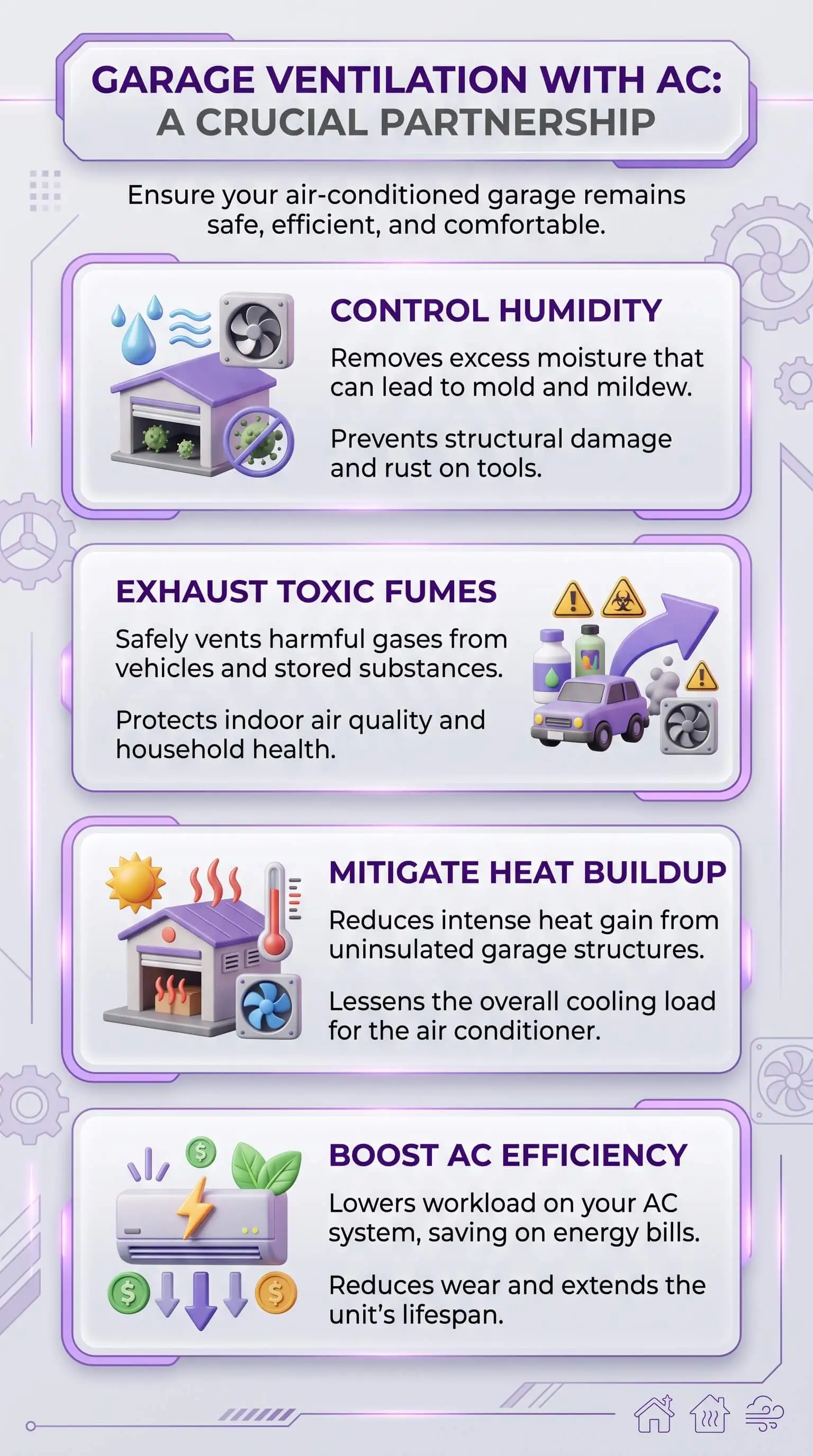
A garage air conditioner removes heat and some moisture, and it does nothing about carbon monoxide, fuel vapor, or solvent fumes.
Exhaust-only ventilation on a timer gives you real air changes without erasing the cooling you paid for.
Air sealing the wall and ceiling you share with the house protects your indoor air more than any fan you can buy.
Cooling a garage creates cold surfaces, and a sealed room with no air change turns humid air into condensation and rust.
A supply or return register in a garage sends garage air through the whole house, and no amount of cooling capacity fixes that.
What a Garage Air Conditioner Actually Removes
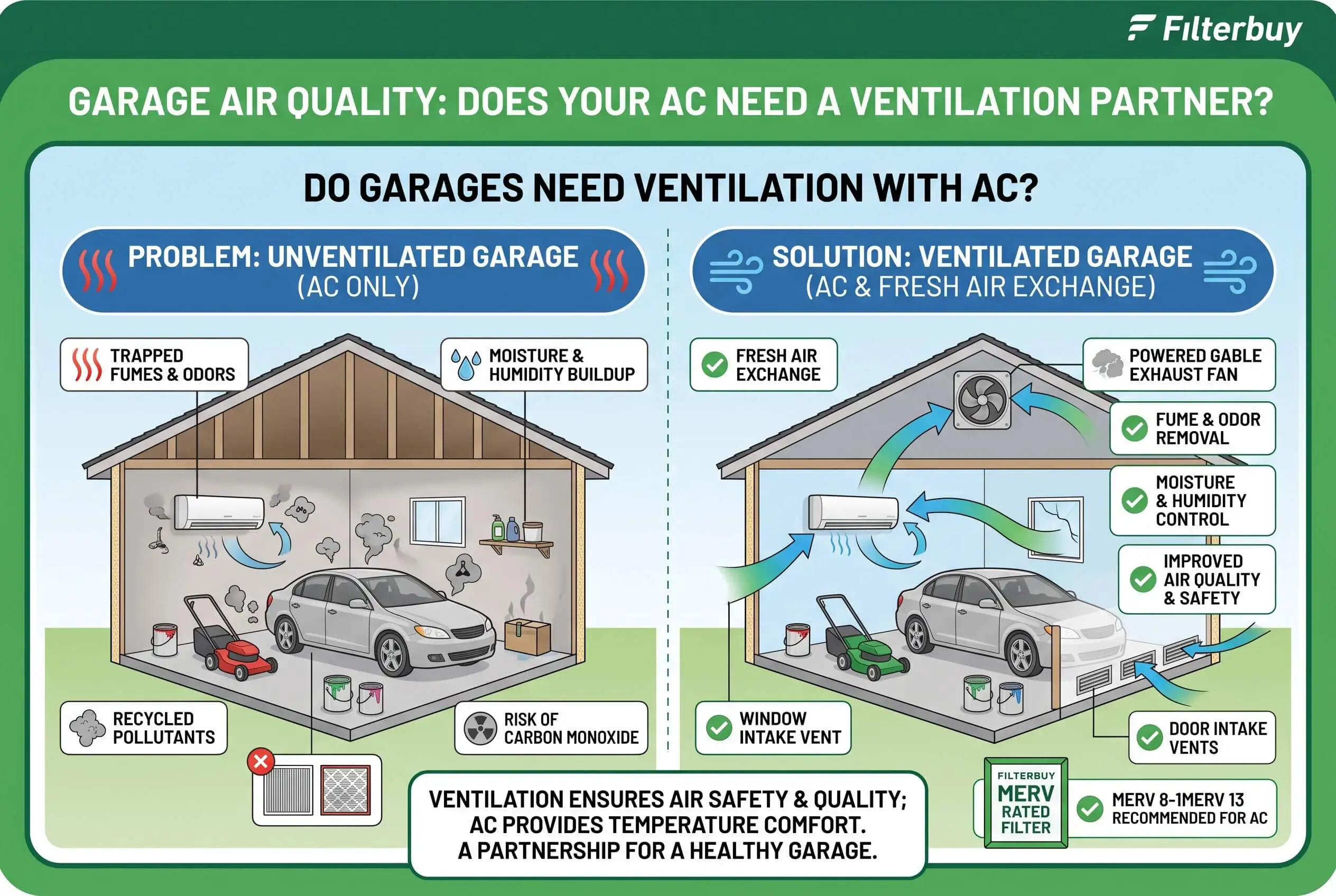
Cooling equipment does two things you can measure. It drops the air temperature, which the trade calls sensible load, and it wrings some water vapor out of the air as that air crosses a cold coil, which is latent load. That's the whole job. Air conditioning moves heat from inside a space to outside it, so nothing in the process dilutes a contaminant or pushes it out the door. Carbon monoxide, gasoline vapor, and paint thinner ride through the unit and come right back out the front of it.
I check this on every garage system I commission. The air temperature falls 15 degrees inside twenty minutes. My handheld fume readings barely twitch.
Three Problems Ventilation Solves That Cooling Cannot
Vehicle exhaust and combustion byproducts
Your car keeps producing carbon monoxide for several minutes after you pull the key, and the exhaust system keeps off-gassing well past that. The part you can't see matters more. An attached garage shares walls and a ceiling with the rooms your family sleeps in, and ordinary pressure differences inside a house pull garage air through every unsealed gap in that boundary. Nobody smells it happening, which is exactly what makes it worth taking seriously. I won't run a generator or a pressure washer inside a garage, and no amount of cooling capacity changes that answer.
Stored fuel and chemical vapor
Look at your garage shelf right now. There's probably a gas can, some two-stroke mix, wood stain, mineral spirits, and a row of half-empty aerosols. Every one of those containers gives off vapor around the clock, and heat speeds it up. Back when the room leaked, air movement carried a good share of that vapor away without anyone giving it a thought. Seal the room and it stays put.
Trapped moisture and condensation
This one blindsides people, because cooling is supposed to help with humidity. It does help, partly. It also creates cold surfaces. A wet car parked in a cooled garage releases a startling volume of water into a room that has nowhere to send it. I've wiped rust off table saw tops that never rusted back when the room ran hot and leaky.
Proper ventilation is just as important as cooling because it removes vehicle exhaust, chemical vapors, and excess moisture that an air conditioner cannot. Understanding these differences also helps prevent common air conditioner problems caused by trapped humidity and poor airflow in a sealed garage.
How to Ventilate Without Fighting the Air Conditioner
The approach I use is exhaust-only, run on purpose instead of around the clock. A through-wall or ceiling fan pulls air out, outdoor air slips in through the door seal and whatever gaps are left, and the garage sits slightly negative compared to the living space. That last part matters more than fan size. A negative garage pushes its own air outdoors instead of into your hallway.
Four rules keep them from fighting each other:
Seal the house boundary first. Air sealing that shared wall and ceiling does more for the air inside your house than any fan you could bolt to the wall, and it costs less than the fan does.
Run the fan on a timer or a switch. Twenty minutes after you pull a car it handles most of the load without erasing the cooling you paid for.
Never tie the garage into the home return. A register out there is a direct pipeline. It turns your entire HVAC system into a delivery service for garage air.
Keep the alarm inside the house. Garage temperature swings shorten sensor life, and the people you're protecting are asleep on the other side of that wall.
When Equipment Choice Changes the Ventilation Plan
Different equipment hands you different amounts of accidental air exchange, and that's worth knowing before you spend anything. A ductless wall unit recirculates garage air and brings in none from outside, so ventilation stays entirely its own job. A window unit leaks a little around the sleeve, which helps you by accident and costs you efficiency. A single-hose portable actively depressurizes the room and pulls its replacement air through wall cavities and the gap under the door, which makes it the least predictable of the three. Reading through the most effective ways to cool a garage alongside your ventilation plan keeps you from fixing one thing and breaking another.
Filtration in a Conditioned Garage
A garage filter eats a completely different diet than a house filter. Sawdust, brake dust, grass clippings, and drywall grit load media far faster than household dust does. In my own testing on garage installs, a MERV 8 media filter caught visible debris well and stayed inside the airflow the equipment wanted, while MERV 11 grabbed noticeably more fine dust and needed replacing about a month sooner. When selecting filtration, keep in mind that standard HVAC air conditioner sizes for home are based on different airflow requirements than garage cooling setups, making proper filter selection just as important as choosing the right equipment. Neither one touches a gas. Filters catch particles, and vapor is a job only ventilation can do.
"In nineteen years of commissioning residential cooling equipment, the garages that called me back were never the ones running too warm. They were the sealed, cooled ones with no exhaust path and a gas can in the corner."
7 Essential Resources
Get straight answers on carbon monoxide before you seal anything
The Consumer Product Safety Commission keeps a plain-language carbon monoxide question and answer page covering sources, alarm standards, and what to do when one goes off. Read the attached-garage section before you tighten up a room you park a car in.
See how garage air ends up in the rooms where your family sleeps
The EPA page on carbon monoxide and indoor air quality lists typical indoor concentrations next to the exposure limits different agencies use. Those numbers let you judge whether a reading you take yourself is normal or worth acting on.
Install your garage exhaust fan the way a builder would
The Department of Energy's Building America Solution Center publishes a builder-grade guide to mechanical ventilation for an attached garage, covering fan placement away from doors and intakes, self-closing door hardware, and the air sealing that has to come first. If you're doing the work yourself, start here.
Put your alarms where they'll actually wake somebody up
The National Fire Protection Association's carbon monoxide safety guidance walks through placement, interconnection, testing, and replacement intervals. Their advice to add detection near an attached garage is the piece most homeowners skip.
Recognize the symptoms early, because they don't announce themselves
The CDC's carbon monoxide poisoning basics explains why exposure gets mistaken for flu and who's most at risk. A headache and some confusion in a garage workshop deserve a second thought.
Cut your cooling bill while you tighten the surfaces that count
ENERGY STAR lays out why sealing and insulating pays off and which surfaces return the most for the effort. Apply that thinking to your shared garage wall and you'll improve comfort in both rooms at once.
Match your ventilation strategy to your climate
The Energy Saver guide to home ventilation runs through spot, whole-house, exhaust, supply, and balanced approaches with minimum airflow figures. Its note that ventilation alone falls short in humid climates explains why a cooled garage still needs a fan.
3 Statistics
Air conditioning was in use in 88 percent of U.S. households as of the 2020 Residential Energy Consumption Survey, and half of Northeast households rely mainly on individual units such as window, wall, portable, or mini split equipment (U.S. Energy Information Administration). That individual-unit category is exactly what ends up bolted to a garage wall.
Federal workplace rules cap carbon monoxide in an enclosed space at 50 parts per million as an eight-hour average, and they require people to be removed once concentration crosses a 100 parts per million ceiling (Occupational Safety and Health Administration). A closed garage with a warm engine in it can cross both figures.
Among newly completed owner-built single-family homes, 91 percent had air conditioning, and only 4 percent of new homes in the West went without it (U.S. Census Bureau). Cooled square footage keeps growing, and garages are following the house.
As more homeowners cool their garages, safe ventilation and proper system design become increasingly important. Pairing your cooling setup with top air filters helps support cleaner airflow, improve HVAC performance, and maintain better indoor air quality throughout the home.
Final Thoughts and Opinion
My opinion comes off a callback list, not out of a catalog. Sequence beats equipment. Seal the wall and ceiling you share with the house, put in an exhaust path, then cool the room. Reverse that order and you've bought a comfortable space that quietly concentrates everything you'd rather your family didn't breathe.
The mistake I run into most is simple enough. People treat a cooled garage like another room in the house, and a bedroom doesn't store gasoline or park a hot engine. Your garage does both, most days of the week, and that difference is the entire reason ventilation stays on the list after the thermostat reads 74. You're the one looking after the air in that house. Comfort and air quality are two separate purchases, and only one of them ever shows up on a thermostat.
Frequently Asked Questions
Does a garage air conditioner need a vent to the outside?
A ductless wall unit needs a refrigerant line set through the wall, not a ventilation duct. A single-hose portable does need an exhaust hose outdoors. Either way your garage still needs its own separate exhaust path, because neither unit brings in a bit of outdoor air on its own.
How much ventilation does an air-conditioned garage need?
It depends. Floor area, ceiling height, and how you actually use the space all move the number, so a one-car garage for parking and fuel storage lands nowhere near a woodshop running a table saw. Have the figure worked out for your room instead of borrowing a number off a fan box.
Can I run my home HVAC into the garage instead?
Don't. A supply register pressurizes the garage and pushes its air into your wall cavities. A return register is the worse of the two, because it pulls exhaust and fuel vapor straight into the ductwork that feeds every bedroom in the house. Proper AC installation keeps the garage on its own dedicated cooling system, ensuring the two air systems stay separate. Keep the two air systems separate and give the garage its own equipment.
Will ventilating the garage waste the cooling I paid for?
Some of it, and less than most people expect. Intermittent exhaust for fifteen or twenty minutes after you pull a car in costs very little. Running a fan continuously costs considerably more, which is why a timer or a door interlock beats leaving it on.
Where should a carbon monoxide alarm go if I cool my garage?
Put it inside the house, in the room or hallway next to the garage and near sleeping areas, at whatever mounting height the manufacturer specifies. Garage temperature extremes shorten sensor life, and the exposure that hurts people happens on the living-space side of that wall.
Does a dehumidifier replace garage ventilation?
It handles moisture and nothing else. A dehumidifier will keep condensation off your tools, and it won't touch carbon monoxide or gasoline vapor. Pair it with an exhaust path instead of treating it as a substitute.
Plan the Ventilation Before You Cool the Garage
Deciding the ventilation path comes before choosing the best air conditioner, because fan location and air sealing shape everything that follows them. Walk the wall your garage shares with your house, mark every penetration you find, and build the exhaust plan around what that walk shows you.